ACIM The Separation and the Atonement – Study Guide
1. Front Matter
Title: ACIM The Separation and the Atonement – Study Guide
Subtitle: Moving from Fear to the Peace of God
Sources: A Course in Miracles (Original Edition/FIP), Chapter 2.
How to Use This Guide
This guide is designed for both individual deep-dives and group facilitation. Each unit is built around a "Multimedia Anchor" to engage the visual and auditory senses, followed by rigorous textual analysis and practical application.
- For Facilitators: Use the "Zoom Experiential Question" to spark dialogue. The "Micro-Scenario" is perfect for role-playing.
- For Students: Use the "Instant Shift" practice throughout your day and the "7-Day Review" to anchor the teachings in your subconscious.
2. Chapter Overview: The Separation and the Atonement
In Chapter 1, the Course introduced the miracle as a natural expression of love. In Chapter 2, the focus shifts from the expression of the miracle to the source of the miracle: the mind. The core theme of "The Separation and the Atonement" is the psychological undoing of the belief that we have successfully separated from our Source.
The "Separation" was not a literal, historical event where God’s children ran away; it was a "detour into fear," a momentary lapse into a dream of lack. Because the separation never truly happened in reality, it does not require a complex "fix." It requires an Atonement—the simple recognition that the error is not true.
This chapter marks a critical transition for the student. It moves us away from trying to "fix" the physical world (the level of effect) and directs us toward the "correction of the belief in separation" (the level of cause). We learn that the ego’s primary tool is fear, which it uses to protect its perceived identity. The Holy Spirit’s tool is the Atonement, a "defense" that cannot be used for attack because it merely affirms the truth. By the end of this chapter, the student should understand that they are not a victim of the world they see, but a mind capable of choosing between the "spirit of doubt" and the "Peace of God."
3. Section-by-Section Study Units
Unit: The Atonement as a Defense (T-2.II)
A. Multimedia Anchors
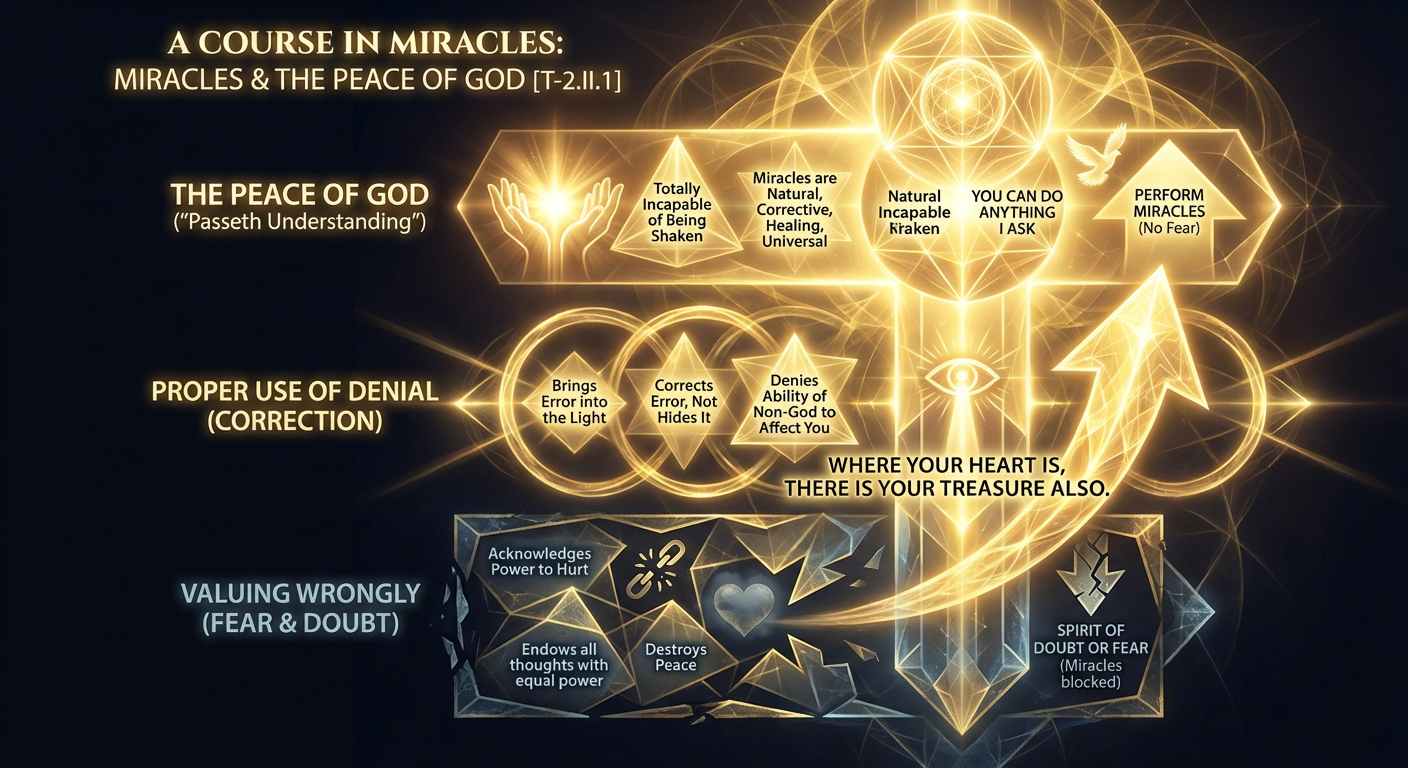
Caption: This visual maps the vertical movement of the mind. At the bottom, "Valuing Wrongly" creates a fractured, dark foundation of fear. As the mind applies "Proper Denial," it rises through the central pillar of the Altar, reaching the "Peace of God" where miracles become natural and the will is restored to freedom.
AI Image Specification (DALL·E/Flux):
A high-contrast, cinematic digital art piece depicting a golden, translucent Altar inside a vast cathedral of light. Below the altar, jagged, dark crystalline shards represent 'errors' and 'fear.' A brilliant, upward-flowing stream of liquid gold (The Atonement) washes over the shards, not crushing them, but turning them into transparent glass that reflects the light. In the center, a single, unblinking eye of peace radiates a geometric halo (The Peace of God). Style: Sacred geometry, ethereal, non-dualism, gold and obsidian color palette.
Audio Integration: [INSERT SUNO SONG LINK: The Atonement as a Defense].
Listening Intention: As you listen, visualize the fear melting away from the Altar of your mind. Feel the "two-edged sword" of your usual defenses being replaced by a soft, impenetrable golden shield that only knows how to heal.
B. Core Concepts & Vocabulary
- The Proper Use of Denial: Unlike ego-denial (which hides truth), ACIM denial is the refusal to grant power to anything not of God. It is saying, "This fear is an error; therefore, it has no power over me."
- Valuing Wrongly: Fear is a symptom of a misplaced value system. If you are afraid, you are valuing something "changeable" (the body, money, status) over the "unchangeable" (the Peace of God).
- The Only Defense: The Atonement is the "only defense that cannot be used destructively." It is a limit set on the belief in separation, ensuring that the "detour" into time is temporary.
Term Watch: Atonement
- Ego’s Definition: A sacrifice or punishment required to pay for "sins" and appease an angry God.
- Holy Spirit’s Definition: The "undoing" of the thought that we ever sinned or separated. It is the recognition of our inherent innocence.
C. Deepening the Understanding
Selected Quotes:
- "You believe in what you value. If you are afraid, you are valuing wrongly." (T-2.II.1:6-7) — Fear is not a fact; it is a diagnostic tool showing us that we have invested our treasure in the illusions of the world.
- "The Atonement is the only defense that cannot be used destructively because it is not a device you made." (T-2.II.4:1) — Human defenses (sarcasm, walls, counter-attacks) always hurt someone. The Atonement only heals because it comes from outside the ego's system.
- "The Atonement saves time, but like the miracle it serves, does not abolish it." (T-2.II.6:6) — We still live in the world of time, but the Atonement allows us to "return as we go forward," collapsing the need for thousands of years of painful "learning."
The "Skeptic's Voice" (Resistance):
- The Resistance: "If I deny that my problems are real, I’m just being delusional. I have bills to pay and people are actually hurting me!"
- The Correction: ACIM isn't asking you to ignore your bills; it's asking you to deny the power of those bills to destroy your peace. When you deny the error's power to hurt you, your mind stays clear. A clear mind solves problems much more effectively than a panicked one.
Micro-Scenario: You receive a harsh, critical email from a supervisor. Your "two-edged" defense wants to draft a snarky reply (attack). Instead, you apply the Atonement: you deny that their words have the power to affect your reality as a Son of God. From this "Peace of God," you write a calm, professional response that de-escalates the conflict.
D. Reflection & Discussion
- Journaling: What is one "treasure" (a physical outcome, a reputation, a specific relationship) that I am currently defending with fear?
- Journaling: Look at a recent moment of "doubt." What was I "valuing" in that moment that was not of God?
- Journaling: How does it feel to think of the Atonement as a "limit on time"? Does the idea of "returning as I go forward" bring me relief?
- Zoom Experiential Question: "In our group today, can we identify one 'common error' we all believe in (e.g., 'there isn't enough time') and practice 'True Denial' on it together? How does the energy in the room shift when we refuse to give that error power?"
E. The "Instant Shift" Practice
Pocket Phrase:
"I deny the power of this error to hurt me. I value only the Peace of God."
4. Core Principles and Comparison Tables
Table 1: Key Terms and Definitions
| Term | ACIM Definition (Paraphrased) | Common Ego Misconception | Practical Application |
|---|---|---|---|
| Atonement | The undoing of the belief in separation. | Paying a price for sins. | Use it to forgive yourself for "making" a mistake. |
| Denial | Refusing to believe error is real. | Suppressing or hiding feelings. | Say: "This fear is not from God; it is not real." |
| Miracle | A shift in perception from fear to love. | A physical event that defies physics. | Choose to see a "difficult" person as a brother. |
| The Altar | The central point of the mind where we choose. | A physical place in a church. | Visualize cleaning the "dust" of fear off your inner Altar. |
Table 2: Creating vs. Making (Levels of Mind)
| Feature | Creating (Spirit/Truth) | Making (Ego/Illusion) |
|---|---|---|
| Source | The Will of God. | The belief in lack/separation. |
| Nature | Eternal, changeless, perfect. | Temporal, shifting, fragmented. |
| Resulting Emotion | Perfect Peace / Joy. | Fear / Anxiety / Doubt. |
| Correction | Not needed (Reality is). | The Atonement (The Undoing). |
5. Integration
Daily Reminders: A 7-Day Review
- Day 1: Today, I will not value anything that fear can touch.
- Day 2: I can do anything Jesus asks of me because his strength is mine.
- Day 3: Denial is my defense of truth. I deny that error has power over me.
- Day 4: My heart is where my treasure is. Today, my treasure is Peace.
- Day 5: The Atonement is a gift of love. I accept it for myself today.
- Day 6: I am "meek" in the world but strong in God. My defense is my defenselessness.
- Day 7: I am returning as I go forward. Time is serving my awakening.
Guided Meditation Script: Cleaning the Altar
(Suggested AI Image Style: Soft focus, golden hour, a minimalist stone altar in a field of white lilies.)
[Pause for 3 breaths]
Close your eyes and breathe into the center of your chest. Imagine that within you, there is a sacred Altar. This Altar was built by God and represents your mind’s capacity to communicate with Him.
Look closely at the Altar. Over the years, you have placed "treasures" upon it that do not belong there. You have placed your fears about money, your grievances against others, and your doubts about your own worth. These things look like heavy, grey stones or thick layers of dust. They "defile" the Altar because they hide the light that is always burning there.
Now, see a brilliant, white light descending from above. This is the Atonement. It is not a fire that burns; it is a light that clears. As the light touches the grey stones of your fears, watch them dissolve into mist. They were never solid; they were only "miscreations."
Repeat silently: "I accept the Atonement for myself."
Watch as the dust of doubt is blown away by a gentle wind. The surface of the Altar is now shining like a mirror. It reflects only the Light of God. You realize that you don't need to "make" anything to be holy; you only need to "un-make" the errors you placed here.
Feel the "Peace of God which passeth understanding" settling over you. It is unshakable. It is your natural state. Spend a moment in this stillness, knowing that any time you feel fear today, you can return to this Altar and let the Atonement clean it once more.
[Pause for 1 minute of silence]
When you are ready, bring this peace back into the room. You are the miracle worker, and your mind is clear. Amen.