ACIM The Separation and the Atonement – Study Guide
1. Front Matter
Title: ACIM The Separation and the Atonement – Study Guide Subtitle: Restoring the Altar of God (Focus on T-2.III)
Introduction Welcome to this workshop-ready study guide. This document is designed to bridge the gap between the profound non-dual metaphysics of A Course in Miracles and the practical, psychological application required for true inner healing.
Sources: This guide utilizes the original text of A Course in Miracles (Chapter 2, Section III) and the accompanying "The Separation and the Atonement" infographic.
How to Use This Guide:
- For Students: Use the "Instant Shift" practices during your day and the journal prompts for evening reflection.
- For Facilitators: Each "Unit" is designed to be a 60-90 minute workshop module. Use the "Multimedia Anchors" to open the session and the "Zoom Experiential Question" to facilitate deep group connection.
2. Chapter Overview: The Great Undoing
Chapter 2 of A Course in Miracles marks a pivotal transition in the student’s journey. While Chapter 1 defined the nature of miracles as expressions of love, Chapter 2—The Separation and the Atonement—dives into the "why" and "how" of our current state of perceived lack.
The core theme is the Correction of the Mind. The text moves us away from the "physical miracle" (the idea that a miracle changes the world) and toward the "mental correction" (the idea that a miracle changes our perception of the world). The separation was not a literal event in time where we left God; rather, it was a "detour into fear." Because the separation is an illusion, it does not need to be "defeated"—it only needs to be undone.
This chapter introduces the Atonement as the Holy Spirit’s specific remedy. It teaches that while we have "made" a world of bodies and defenses, we have never ceased "creating" in the realm of Spirit. The focus of Section III, "The Altar of God," is the internal sanctuary where this correction takes place. We are invited to stop defending the "temple" of the body and start recognizing the holiness of the "altar" within the mind. This is the shift from physical sight, which sees only structures and differences, to spiritual vision, which sees only the need for Atonement and the light of Truth.
3. Section-by-Section Study Unit: The Altar of God (T-2.III)
A. Multimedia Anchors
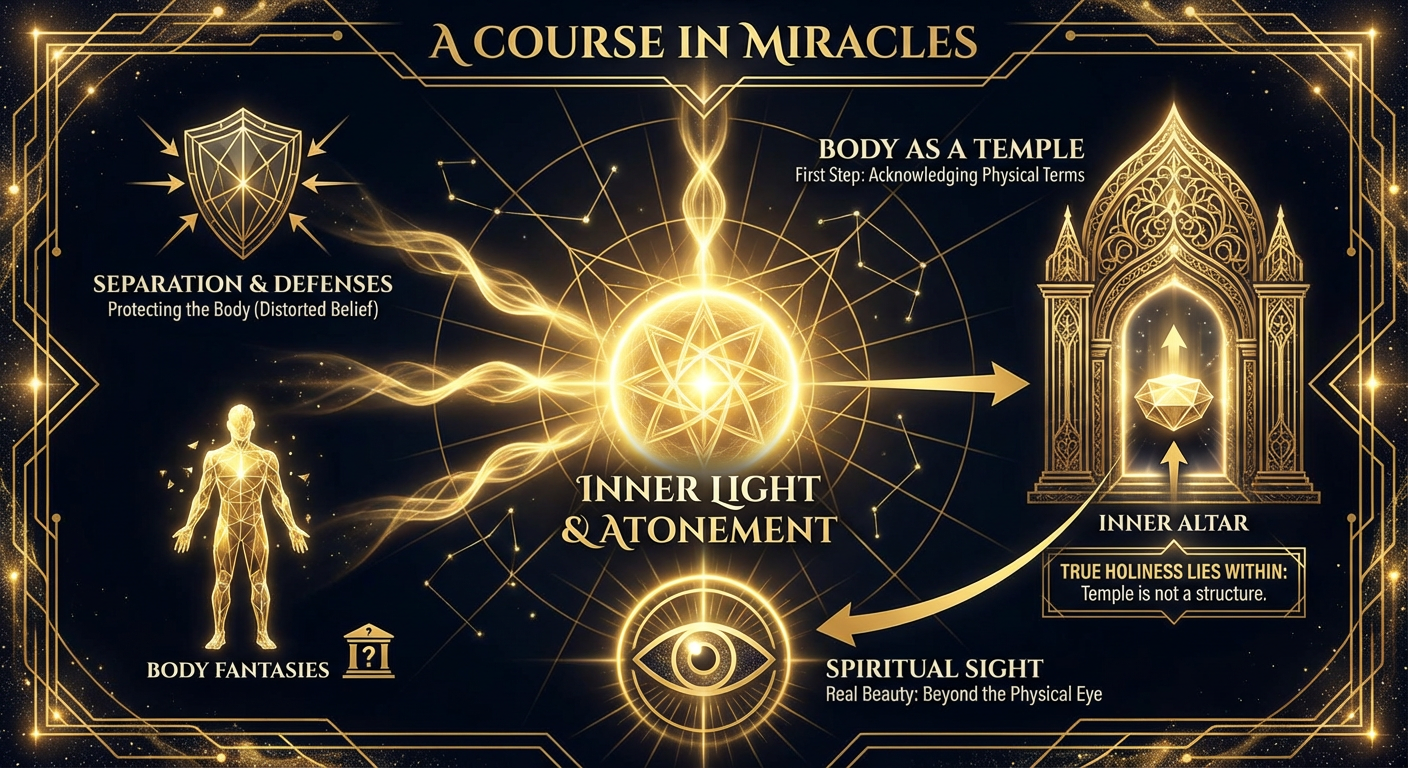
Caption: This visual maps the journey from the "Body Fantasies" and "Defenses" of the ego to the "Inner Light" of the Altar. It illustrates that while the ego tries to protect the physical structure, Spiritual Sight looks past the structure to the diamond-light of Atonement at the center of the mind.
AI Image Specification (DALL·E/Flux Prompt):
A high-resolution, ethereal digital art piece depicting a transparent, crystalline human silhouette standing in a void. Inside the chest area, where the heart would be, is a radiant, golden geometric altar holding a glowing diamond. Surrounding the figure are crumbling stone walls of an ancient temple, dissolving into golden dust. A large, translucent "all-seeing eye" of compassion floats in the background, emitting rays of light that bypass the stone walls and strike the central diamond. Cinematic lighting, sacred geometry, non-dual aesthetic, gold and deep indigo color palette.
Audio Integration: [INSERT SUNO SONG LINK: The Altar of God]
Listening Intention: "As you listen, visualize the fear melting away from the Altar. Feel the music acting as a gentle wind, blowing away the 'dust' of body-fantasies, revealing the unshakable diamond of Atonement that has always been at your center."
B. Core Concepts & Vocabulary
Key Ideas:
- The Body as a Step, Not the Goal: Perceiving the body as a "temple" is a helpful first step because it stops us from using the body for low purposes, but the final step is realizing the "temple" isn't a physical structure at all—it is the Mind.
- Defenses Against Truth: We use defenses (like health obsession or physical protection) primarily to keep the Atonement out, because the Atonement would end the ego’s version of "identity."
- The Limit of Pain: The Course reassures us that while we can procrastinate, we cannot truly escape God. Our "tolerance for pain" is not limitless; eventually, the discomfort of separation becomes so high that we must choose a better way.
- Spiritual Vision’s Function: Spiritual vision is "perfect vision" because it literally cannot see error. It doesn't see a "sick person" or a "sinner"; it only sees a brother in need of Atonement.
Term Watch: Atonement
- Ego’s Definition: A way to "pay" for sins; a sacrifice required by a vengeful God to make up for mistakes.
- Holy Spirit’s Definition: The undoing of the belief that we ever sinned or separated. It is a "correction" that restores the mind to its natural state of wholeness.
C. Deepening the Understanding
Selected Quotes:
- "The Atonement can only be accepted within you by releasing the inner light." (T-2.III.1:1) — This connects to the central sun in the infographic; the light isn't coming from outside, but is released from within.
- "Spiritual sight... cannot see the structure at all because it is perfect vision. It can, however, see the altar with perfect clarity." (T-2.III.1:11-12) — The visual eye sees the "temple" (the body/the world), but the "Spiritual Sight" icon in our map looks straight through the form to the content (the Altar).
- "God is lonely without His Sons, and they are lonely without Him." (T-2.III.5:11) — This poignant quote humanizes the metaphysics, showing that the drive for Atonement is a drive for the end of a deep, existential loneliness.
The "Skeptic's Voice" (Resistance):
- The Resistance: "If the body isn't real and the temple isn't a structure, I feel like I'm disappearing. This feels like I have to give up my health, my safety, and my very self."
- The Correction: The Course isn't asking you to neglect the body, but to stop worshipping it as your identity. By shifting your identity to the Altar (the Mind), you actually gain "perfect comfort" and "perfect trust." You aren't losing yourself; you are losing the fear that has kept you feeling small and vulnerable.
Micro-Scenario: You are stuck in traffic and late for a meeting. Your heart races (Body Fantasy/Defense). You feel "attacked" by the traffic.
- Application: You pause and realize you are trying to "protect" your image (the structure). You shift your focus to the "Inner Altar," acknowledging that your peace is independent of the car's movement. You offer the situation to Atonement, and the "acute conflict" begins to dissolve into a sense of "better way."
D. Reflection & Discussion
- Reflection (Journal): In what ways have I been treating my body—or the "structures" of my life (career, house, reputation)—as the source of my holiness rather than the Altar within?
- Reflection (Journal): Look at the "Body Fantasies" section of the infographic. What specific fantasies (fears of illness, dreams of physical perfection) do I use to distract myself from the "Inner Light"?
- Reflection (Journal): The text says our "tolerance for pain is not without limit." Can I identify a recent "turning point" where a situation became so intolerable that I finally became willing to say, "There must be a better way"?
- Zoom Experiential Question: "If you were to look at the person currently speaking on your screen through 'Spiritual Vision'—ignoring their physical appearance, their background, and their words—what 'light' or 'altar' do you sense behind the structure?"
E. The "Instant Shift" Practice
Pocket Phrase: "This [situation/fear] is just a structure; I choose to see the Altar."
Micro-Practice: When you feel a "minor intrusion of discomfort" (T-2.III.4:7), close your eyes for 5 seconds. Visualize a diamond at the center of your mind. Mentally place the discomfort on that diamond and watch it be consumed by golden light. Say: "I accept the Atonement for myself."
4. Core Principles and Comparison Tables
Table 1: Key Terms and Definitions (The Separation and the Atonement)
| Term | ACIM Definition (Paraphrased) | Common Ego Misconception | Practical Application |
|---|---|---|---|
| The Altar | The central point in the mind where we communicate with God. | A physical place in a church or a ritualistic object. | Go "within" when feeling stressed to find the quiet center. |
| Body Fantasies | The belief that the body can provide satisfaction or is the cause of pain. | The body is who I am and it dictates my happiness. | Remind yourself: "I am not a body; I am free." |
| Spiritual Sight | Perception that ignores error and looks only for the light of Truth. | "Seeing" ghosts, spirits, or physical light with the eyes. | Look past a person's anger to see their hidden call for love. |
| Defenses | Mental maneuvers used to keep the belief in separation alive. | Necessary tools for physical and emotional safety. | Ask: "What am I trying to hide from the light of Atonement?" |
Table 2: Creating vs. Making (Levels of Mind)
| Feature | Creating (Spirit/Truth) | Making (Ego/Illusion) |
|---|---|---|
| Source | God / Holy Spirit | The Separated Will / Ego |
| Nature | Eternal, changeless, perfect | Temporary, shifting, fearful |
| Resulting Emotion | Perfect Peace / Joy | Anxiety / Conflict / Guilt |
| Correction | Not needed (Truth is) | Atonement (Undoing the "make") |
5. Integration (End of Chapter)
Daily Reminders: A 7-Day Review
- Day 1: Today, I recognize that my body is a temple, but my mind is the Altar.
- Day 2: I will not use defenses to hide from the light of Atonement.
- Day 3: My tolerance for pain is limited; I choose the "better way" of peace today.
- Day 4: Spiritual vision sees no error. I ask to see my "enemies" as they truly are.
- Day 5: I am entitled to perfect comfort through perfect trust.
- Day 6: The Atonement is the only gift worthy of the Altar of God.
- Day 7: God is not lonely, for today I choose to accept my union with Him.
Guided Meditation Script: "Cleaning the Altar"
(Suggested AI Image Style for Meditation: "Soft focus, bokeh golden lights, a path of white lilies leading to a sun-drenched inner chamber.")
[Begin in a comfortable position. Close your eyes and take three deep, clearing breaths.]
Visualize yourself standing before a great, ancient structure. This is the "Temple" you have built. Notice the walls—they are made of your past experiences, your fears, your defenses, and your physical concerns. The air here feels heavy and dim.
Now, look past the walls. In the very center of this structure, there is a glow. You walk toward it. As you move closer, the walls of the temple begin to become transparent. You realize they have no substance.
You reach the center. There stands the Altar of God. It is a simple, radiant pedestal of pure light. However, it is covered in a layer of fine, grey dust. This dust represents every "body fantasy," every "separation thought," and every "minor intrusion of discomfort" you have held onto today.
The Holy Spirit stands beside you. He does not judge the dust. He simply hands you a cloth of pure light. Together, you begin to wipe the Altar clean. With every swipe, a memory of fear vanishes. With every swipe, a belief in your own inadequacy dissolves.
See the diamond at the center of the Altar beginning to shine. This is the Atonement. It is the guarantee that you are still as God created you. The light from the diamond grows, expanding outward. It touches the walls of your "temple" and they vanish completely. There is no structure left—only the Altar, and the infinite light of God surrounding it.
You are not a body. You are not a structure. You are the light at the Altar.
Stay in this light for a moment. Feel the "perfect comfort" that comes from "perfect trust." There is nothing to defend. There is nothing to protect. You are safe. You are home.
[When you are ready, gently return your awareness to the room, carrying the light of the Altar with you.]
6. Execution Instructions (Final Note)
This guide maintains strict fidelity to the ACIM principle that the separation never occurred in reality. Every exercise and explanation is designed to lead the student back to the "Inner Altar," where the only real choice—the acceptance of the Atonement—awaits. Use the provided tables to clarify the difficult vocabulary of Chapter 2, and rely on the "Instant Shift" practices to ensure the theology becomes a lived experience.