ACIM The Separation and the Atonement – Study Guide
1. Front Matter
Title: ACIM The Separation and the Atonement – Study Guide
Subtitle: From the Detour of Fear to the Radiance of Reality
Sources: A Course in Miracles (Original Edition/FIP), Chapter 2, Section I.
How to Use This Guide
This guide is designed for both individual deep-dives and group facilitation. Each unit combines visual, auditory, and contemplative elements to move the teaching from the head to the heart.
- For Facilitators: Use the "Zoom Experiential Question" to spark dialogue and the "Micro-Scenario" to ground abstract concepts in daily life.
- For Students: Use the "Multimedia Anchors" to bypass the ego’s intellectual defenses before reading the text.
2. Chapter Overview
Summary: The Undoing of the Impossible
Chapter 2 of A Course in Miracles, "The Separation and the Atonement," marks a pivotal shift in the student's journey. While Chapter 1 defined the nature of miracles as expressions of love, Chapter 2 addresses the root cause of why we believe we need miracles in the first place: the belief in separation.
The core theme of this chapter is that the separation from God never actually occurred; it was merely a "detour into fear." The text introduces the Atonement not as a religious sacrifice for sin, but as the "undoing" of the belief that we could ever be separate from our Source. The chapter moves the student from the level of physical symptoms (illness, conflict, lack) to the level of the mind. It asserts that all fear is born from a single, fundamental error: the belief that we have usurped the power of God and created ourselves.
The Shift: From Physical to Mental Correction
In Chapter 1, we learn that miracles are "maximal" and "natural." In Chapter 2, we learn that the miracle’s primary function is to correct the "distortions" of the mind. We move from looking at the world to looking at the altar within. The chapter emphasizes that "Health is inner peace," and that by accepting the Atonement, we recognize that our perceived errors—no matter how horrific they seem in the "nightmare" of the world—never actually happened in the reality of God.
3. Section-by-Section Study Units
Unit: The Origins of Separation (T-2.I)
A. Multimedia Anchors
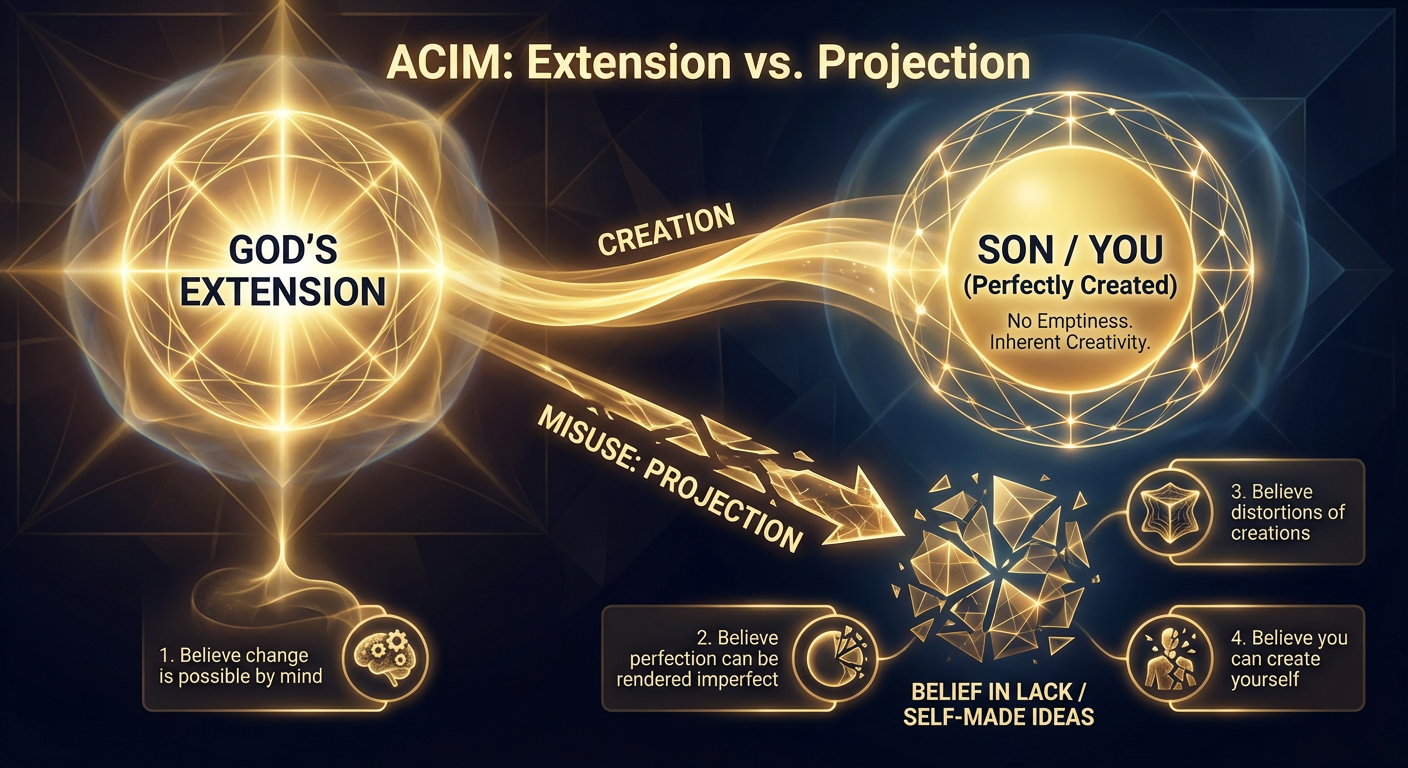
Caption: This visual maps the transition from God’s Extension (the flow of pure creation) to the ego’s Projection (the fractured belief in lack). It highlights the four specific mental steps that lead to the "detour into fear" and the eventual fracturing of our self-perception.
AI Image Specification (DALL·E/Flux Prompt):
A high-contrast cinematic digital art piece. On the left, a massive, radiant golden sphere of interconnected geometric light (The Source), extending a smooth, flowing river of liquid gold toward a smaller, identical golden sphere (The Son). Below this flow, a jagged, dark crystalline arrow breaks off, shattering into sharp, disconnected shards of dull glass. Each shard contains a faint, distorted reflection of a human face looking lost. The background is a deep cosmic indigo. The atmosphere is one of profound peace on top and chaotic fragmentation below. 8k resolution, sacred geometry style.
Audio Integration: [INSERT SUNO SONG LINK: The Origins of Separation]
Listening Intention: As you listen, visualize the "inner radiance" mentioned in the text. Feel the music melting away the sharp, jagged edges of your "self-made" ideas, allowing the smooth flow of God’s extension to wash over your mind.
B. Core Concepts & Vocabulary
- Extension vs. Projection: Extension is the natural flow of Spirit, creating like itself (Internal Radiance). Projection is the ego’s attempt to fill an imagined "emptiness" by throwing its internal sense of lack onto the world.
- The "Deep Sleep" of Adam: The text suggests that the "separation" is a dream state. Just as Adam fell into a deep sleep in Genesis, the mind is currently dreaming of fear, and the Atonement is the "light" that wakes us up.
- The Four Steps of Distortion: The process of "making" the ego involves believing: (1) We can change God’s creation, (2) Perfection can lack, (3) We can distort truth, and (4) We are our own creators.
- The Order of Difficulty: There is no order of difficulty in miracles because the miracle only distinguishes between truth and error—it doesn't care how "big" the error seems.
Term Watch: Atonement
- Ego’s Definition: A fearful payment for sins; a sacrifice required by a vengeful God to "make up" for our mistakes.
- Holy Spirit’s Definition: The undoing of the belief that we ever sinned or separated. It is the simple recognition that the error never occurred.
C. Deepening the Understanding
Selected Quotes:
- "There is no emptiness in you." (T-2.I.1:4) – This counters the infographic’s "Belief in Lack." If you are full, you have no need to project.
- "The world has not yet experienced any comprehensive reawakening or rebirth." (T-2.I.3:7) – This connects to the "Deep Sleep" imagery; we are currently navigating a collective nightmare.
- "Health is inner peace." (T-2.I.5:11) – This redefines health from a biological state to a mental state of non-resistance.
The "Skeptic's Voice" (Resistance):
- The Thought: "If I didn't create myself, then I have no autonomy. I’m just a puppet of God. I’m afraid of losing my unique identity."
- The Correction: The text reassures us that our "free will was given [us] for [our] joy in creating the perfect." You aren't losing identity; you are losing the limitation of a self-made identity that is constantly under threat. You are regaining the power to create as God creates—limitlessly.
Micro-Scenario: You feel a pang of jealousy because a colleague got a promotion you wanted.
- Projection: You believe you "lack" success and project "unfairness" onto your boss.
- Correction: You realize the "emptiness" is an illusion. You accept that your worth is inherent (Extension) and not dependent on external roles. The jealousy (the nightmare) vanishes in the light of your true abundance.
D. Reflection & Discussion
- Journaling: Which of the "Four Steps of Distortion" do I find myself doing most often? (e.g., Do I try to "create myself" through my career or appearance?)
- Journaling: If I truly believed there was "no emptiness" in me right now, what would I stop trying to "get" from others?
- Journaling: Think of a "nightmare" situation in your life. If the Atonement means "this never really happened in truth," how does that change your level of fear?
- Zoom Experiential Question: "The text says the miracle makes no distinctions among misperceptions. Can we as a group identify one 'small' worry and one 'huge' fear, and practice seeing them as equally unreal?"
E. The "Instant Shift" Practice
Pocket Phrase: "I am dreaming a detour into fear; I choose to wake up to the light of Atonement." (Use this when you feel the "jagged shards" of projection starting to color your day.)
4. Core Principles and Comparison Tables
Table 1: Key Terms and Definitions
| Term | ACIM Definition (Paraphrased) | Common Ego Misconception | Practical Application |
|---|---|---|---|
| Atonement | The undoing of the error of separation. | Penance or punishment for sins. | Forgiving yourself for "mistakes" by realizing they didn't change your soul. |
| Extension | The outward flow of Spirit/Love from the Source. | "Giving" in order to get something back. | Sharing a kind thought without needing a "thank you." |
| Projection | Seeing your own imagined lack in others. | An objective observation of someone else's faults. | When judging another, ask: "What 'emptiness' in me am I trying to fill?" |
| The Altar | The central point of the mind where we choose God or Ego. | A physical place in a church. | Checking your "inner altar" for "dust" (fear) throughout the day. |
Table 2: Creating vs. Making (Levels of Mind)
| Feature | Creating (Spirit/Truth) | Making (Ego/Illusion) |
|---|---|---|
| Source | Internal Radiance (God) | Belief in Lack (Self) |
| Nature | Eternal, Perfect, Unified | Temporary, Distorted, Fractured |
| Resulting Emotion | Joy, Peace, Certainty | Fear, Anxiety, Guilt |
| Correction | Natural Extension | Acceptance of Atonement |
5. Integration (End of Chapter)
Daily Reminders: A 7-Day Review
- Day 1: Today, I remember that I am as God created me; there is no emptiness in me.
- Day 2: I will not use my mind to project, but to extend the love I have received.
- Day 3: Fear is only a detour. Today, I choose the direct path to peace.
- Day 4: I am not a self-made man/woman. I am a creation of Love.
- Day 5: There is no order of difficulty in the miracles I offer or receive today.
- Day 6: My health is my inner peace; I will not search for it outside myself.
- Day 7: I accept the Atonement for myself, realizing my errors never occurred.
Guided Meditation Script: Cleaning the Altar
(Suggested AI Image Style: A serene, white marble sanctuary with a central stone altar. A single beam of pure white light hits the altar, dissolving gray dust into gold sparkles.)
The Script: (Read slowly with pauses)
Close your eyes and take a deep breath. Imagine that within the very center of your mind, there is a silent, holy sanctuary. In the middle of this room stands an Altar. This is the place where you communicate with your Creator.
Look closely at the Altar. For a long time, you have allowed the "dust" of the world to settle here. This dust is made of your fears, your beliefs in lack, and your projections. It looks like gray soot—the belief that you are separate, that you are guilty, or that you are a body.
The text tells us that the "separation" was a detour into fear. See those fears now as nothing more than harmless dust on a perfect surface.
Now, visualize a Great Light being turned on above the Altar. This is the Light of Atonement. As the light hits the Altar, notice something miraculous: The dust doesn't need to be scrubbed. It doesn't need to be punished. In the presence of the Light, the dust simply vanishes. It was never really there; it was only a shadow of a dream.
Say silently to yourself: "I accept the Atonement for myself. I allow the light to show me that my errors never occurred."
Feel the "inner radiance" that the text speaks of beginning to glow from within the Altar itself. This radiance is your inherent creativity. It is your power to extend love. You are not "making" this light; you are simply allowing it to be seen.
The Altar is clean. Your mind is healed. You are not a self-made creature of fear; you are a perfect extension of God. Stay in this stillness for a moment, knowing that whenever you feel fear today, you can return to this Altar and let the Light do the undoing for you.
When you are ready, gently open your eyes.
6. Execution Instructions
- Formatting: This document uses H2 and H3 headers for easy navigation.
- Theology: Strict adherence to the principle that separation is an illusion and Atonement is the correction of perception.
- Completeness: This guide covers the foundational metaphysics of Chapter 2, Section I, providing a template for subsequent sections.